The Precision Performance Center: Football’s Next Competitive Frontier
By Dave Wollman
“I’ve been thinking about this for twenty years. Indiana just proved I was right.”
———
Twenty Years
I want to tell you where this idea came from.
Not from watching Indiana’s championship season. Not from reading a research paper on motor learning. Not from a conversation with a football coach.
This idea came from forty years of standing on the infield of a track, watching elite athletes repeat the same movement thousands of times, and understanding something that took me years to fully articulate.
Repetition alone doesn’t make athletes better.
Corrected repetition does.
I spent my career coaching throwers and jumpers at the Olympic level. My athletes won more NCAA individual championships and set more collegiate records in the throws and jumps than any coach in NCAA history. That didn’t happen because I found stronger athletes than everyone else. It happened because I built systems that delivered the right feedback, at the right moment, consistently enough that movement patterns changed permanently.
For the last twenty years I have been watching college football and asking one question.
Why hasn’t football built that system?
The sport has transformed itself in almost every area of athlete development. Strength and conditioning. Nutrition science. Recovery technology. Sports medicine. Analytics. Each of those investments represented a moment when football said — there is a better way to develop athletes, and we are going to build a structure around it.
But one area has remained largely untouched.
Structured technical movement development. The complete loop — repetition, feedback, correction, improvement — operating not just during the season, not just during spring practice, but twelve months a year.
I kept waiting for football to solve it.
It didn’t. And then Indiana happened.
What Indiana Confirmed
I’ve spent the first three articles in this series telling you what I observed when I watched Indiana play — and being honest about what I don’t know.
I don’t have inside knowledge of their program. I haven’t sat in their meeting rooms or watched their offseason development. I can’t tell you with certainty exactly what they did or how they did it.
What I can tell you is what I saw on the field.
Good athletes performing like great athletes. Consistently. Under pressure. In the biggest games of the season.
Defensive backs squaring up in open space and making tackles they had no business making at that level of competition. Offensive linemen holding their technique one-on-one, play after play, without breaking under the pressure of a national championship run. Two running backs rotating in and out of the game with no drop in execution standard — different athletes, same movement quality, same technical discipline, same results.
And a quarterback who had been perfectly capable at his previous program and became the first overall pick in the NFL Draft in one season with one staff.
I’ve been studying human movement for forty years. What I watched Indiana do is not what happens when you simply recruit better athletes or install a better scheme. What I watched is what happens when a coaching staff creates an environment where athletes receive meaningful feedback, correct their movement, and repeat it until it becomes automatic.
That is the complete motor learning loop.
And Indiana running it at a championship level confirmed something I have believed for two decades: football is ready for the Precision Performance Center.
The Problem It Solves
Before I describe what the PPC is, I want to be precise about the problem it solves — because understanding the problem is what makes the solution make sense.
College football has a structural gap in how it develops athletes technically.
It isn’t a gap in knowledge. Position coaches understand technical development extremely well. Walk into any major program in America and you will find brilliant football minds who know exactly what efficient movement looks like at every position.
The gap is in structure.
NCAA offseason limitations, recruiting demands, game preparation, and the sheer complexity of running a modern football program make it nearly impossible for position coaches to supervise every technical repetition their athletes perform outside of formal practice windows. The result is that athletes spend enormous amounts of time repeating movement — in the weight room, on their own, in informal workouts — without structured feedback systems ensuring those repetitions are mechanically correct.
Over time, repetition without correction doesn’t improve movement. It makes whatever movement exists more permanent.
If the movement is efficient, those repetitions compound into excellence. If the movement has flaws — and almost every athlete’s movement has flaws — those repetitions engrave the flaws deeper into the nervous system until they become the automatic response under pressure.
This is the development gap. And it exists at every program in America right now.
What the Precision Performance Center Is
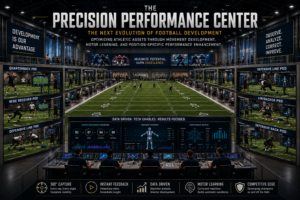
The Precision Performance Center is a structured technical development system designed to deliver the complete motor learning loop — repetition, feedback, correction, improvement — within the existing rules that govern every football program equally.
It is not a facility concept. It is a developmental system that can be built inside a facility.
It is not a replacement for position coaches. It is an infrastructure that amplifies what position coaches already know and makes it possible for every athlete on the roster to actually develop to the standard those coaches have established.
It is not a violation of NCAA rules. It is specifically designed around the reality of modern NCAA compliance — and as you will see, recent rule changes have made it more achievable than ever before.
The Development Flow
The PPC operates on a four-stage motor learning model that movement science has validated over decades.
Stage One — Cognitive Understanding. Before an athlete repeats a movement, they must understand it. Where their body needs to be. Why positioning matters. What efficient movement should feel like. Without this foundation, repetition becomes random. The PPC establishes technical awareness before technical speed.
Stage Two — Structured Technical Repetition. Athletes repeat specific movement patterns within controlled environments. Leverage positions. Foot placement. Force sequencing. Balance. Acceleration mechanics. Body posture. The objective is correct movement first — building the neurological foundation that speed and power can eventually be applied through.
Stage Three — Self-Correction Through Technology
This is where the Precision Performance Center separates itself from every development model that came before it.
The question coaches always ask at this point is the right one: how does an athlete self-correct without a coach standing next to him? He can’t watch himself in a mirror doing a pass protection kick-step. He can’t feel a hip angle that’s two degrees off. He can’t perceive his own center of mass shifting at the wrong moment in a route.
That was true twenty years ago. It is not true today.
Here is what the technology ecosystem that already exists makes possible inside a PPC pod.
An athlete walks into the training pod. The position coach has already defined the technical priorities for that athlete — the specific movement patterns, the specific drills, the specific standards he needs to achieve. The pod is already configured for him. Cameras are in place — not one camera, but multiple cameras capturing every plane of movement simultaneously. Frontal. Lateral. Posterior. The multidimensional capture that meaningful biomechanical analysis requires. No setup required. No technician needed. The athlete walks in, initiates the session, and goes to work.
He performs his repetitions. Every rep is captured from every angle in high definition. When the session is complete, he saves the footage. It uploads automatically to the cloud. Done. He walks out. The entire interaction with the technology took thirty seconds.
That footage is now in the hands of the Movement Development Specialist.
What does the movement specialist do with it? This is where the system becomes genuinely powerful — and genuinely modern.
The movement specialist runs the footage through a customized analysis pipeline built specifically for this program, this position, and these drills. Platforms like VueMotion use AI-powered computer vision to generate detailed biomechanical models capturing the complexity of athlete movement in a natural environment — measuring joint angles, center of mass position, force sequencing, balance, and movement efficiency across every frame. Uplift Labs’ AI-powered computer vision can replace what previously required a $50,000 motion-capture lab, delivering movement assessment algorithms that identify technical patterns and translate complex biomechanical data into actionable insights. AI skeleton overlays track body movement and measure angles with precision, allowing side-by-side video comparison of two performances without sensors or bulky hardware.
Platforms like Hudl — already the industry standard in college football for game film — now combine AI-powered video and data to deliver deeper insights for coaches at every level. Dartfish provides deep biomechanical analysis of an athlete’s form, transforming raw footage into actionable data with personalized feedback for each player. Onform allows coaches to capture, review, and share HD video with frame-by-frame playback, drawing annotation, and side-by-side comparisons — and send annotated video feedback asynchronously so athletes receive and watch it on their own schedule.
But the movement specialist doesn’t stop at off-the-shelf analysis. This is the part that requires human expertise — specifically, his expertise. He has built position-specific AI agent pipelines that understand exactly what the position coach wants each movement to look like. Not generic athletic movement. Not general biomechanical efficiency. The specific technical standard established by the offensive line coach for a pass protection kick-step. The specific hip turn and shoulder angle required by the defensive backs coach for an off-coverage transition. The exact body position the linebackers coach demands at the moment of first contact.
The AI identifies how close this athlete’s movement came to that standard. It measures the joint angles. It tracks the center of mass. It flags the specific frame where the technique broke down and identifies exactly what broke down — hip too high, weight too far forward, first step too wide, pad level rising too early. It compares this session to the previous session and shows whether the movement pattern is improving, stable, or regressing.
Within 24 hours of the training session — before the athlete’s next practice — that athlete receives a complete technical report. Not a general observation. A specific, documented, visually supported analysis of exactly what his movement looked like, exactly where it deviated from the standard, and exactly what needs to improve in the next session.
The athlete never needed to be in the same room as the movement specialist for any of this to happen.
He can read the report on his phone. He can watch the annotated video. He can see his own movement from three angles simultaneously, with joint tracking overlaid, at a fraction of real-time speed, with the specific moment of technical breakdown highlighted.
And then — within the NCAA rules that govern every program equally — if the athlete wants to go further, he can. He can walk into the movement specialist’s office voluntarily. He can sit down and say: I need to understand what you wrote in this report. Walk me through it. Show me what you saw. That voluntary office meeting is permitted. That conversation is teaching. It deepens the athlete’s cognitive understanding of his own movement in a way that accelerates everything that happens in the next pod session.
No mandatory practice. No CARA hours consumed. No rules violated.
Just an athlete who understands his own movement better after every single session — because the feedback loop closes within 24 hours, every time, whether a coach was physically present for the training or not.
That is what self-correction actually looks like in 2026. Not a mirror. Not a feeling. Not a coach’s memory of what he thought he saw from twenty yards away during a crowded practice. A complete, documented, AI-assisted technical analysis delivered before the next repetition occurs.
Stage Four — Automatic Performance Under Pressure. When efficient movement patterns become neurologically stable, athletes maintain technical consistency under fatigue and competitive stress. The fourth quarter looks like the first quarter. Late-season execution holds up the way early-season execution does. The movement patterns have become the athlete’s default — not just their best effort.
Great Teaching Creates Depth
Here is an idea I want to plant in the mind of every coach reading this — because it may be one of the most underappreciated competitive advantages in all of football.
Great teaching doesn’t simply create better starters. Great teaching creates exceptional depth.
Every program has injuries. Every program loses players during a season. The difference between championship teams and everyone else often isn’t that championship teams avoid injuries — it’s that their performance changes the least when injuries occur.
When every athlete has learned efficient movement — when every athlete has received thousands of quality repetitions supported by immediate feedback — the second-team player begins performing much closer to the level of the starter. There may still be measurable physical differences. One athlete may run a slightly faster forty. Another may have a higher vertical. Those differences never disappear entirely. But technical efficiency narrows the performance gap in ways that pure athleticism cannot.
That is not a theory. That is what great teaching does.
Great recruiting determines who arrives on your campus. Great teaching determines how many of them leave playing beyond what anyone thought possible.
The People Who Make It Work
The PPC introduces a role that doesn’t currently exist in college football in any organized way.
The Movement Development Specialist.
This is not a football coach. This is not someone who calls plays, installs schemes, or recruits. This is a trained specialist whose entire professional responsibility is improving movement efficiency — organizing development sessions, reinforcing the technical standards already established by the position coach, monitoring repetition quality, facilitating video review, and supporting athlete self-correction.
The position coach defines the standard. The Movement Development Specialist helps every athlete on the roster actually achieve it.
Think about how football already uses this model in other areas. The strength coach doesn’t call plays. The sports medicine staff doesn’t install schemes. The analytics team doesn’t recruit. Each specialist serves the program by going deep into one area that the position coach doesn’t have time to go deep into alone. The Movement Development Specialist is that same model applied to technical development.
There is only one prerequisite for this role.
To teach movement science you have to understand it. And you have to be able to teach it. That’s it. That is the whole requirement.
And here’s something worth considering: that person may already be on your staff.
The Coach Who Was Born for This Role
Every coaching staff has one.
The coach who came into this profession because he loves the teaching. The one who stays late breaking down movement film when everyone else has gone home. The one who lights up during individual periods and finds recruiting to be the least fulfilling part of the job he signed up for.
That coach doesn’t have to leave the program to become its movement development engine. He may already be the most valuable technical mind in the building — currently spending months of his year on airplanes recruiting instead of doing the work he does best.
Programs can organize the PPC any way that fits their staff and their culture. One model keeps that coach as a position coach who doubles as the movement specialist during the offseason. Another model gives him the PPC as his primary responsibility year-round, with recruiting handled by someone else.
There is no single right structure. But the question every program should ask is this: are we deploying our best teachers where their teaching can create the most competitive advantage?
Rethinking Who Recruits
Here is a question worth asking openly.
Was the position coach ever meant to be a full-time recruiter?
Recruiting today is a full-time sales job. It requires months on the road, deep institutional knowledge, genuine enthusiasm for the university, and the ability to walk into a living room and make a teenager and his family believe their future belongs at your school. That is a specific skill set. And it has almost nothing to do with teaching a defensive back to square his shoulders in open space.
Some coaches are extraordinary at both. But many of the best teachers in football are not natural salesmen. And many of the best recruiters are not the ones you want spending every afternoon breaking down movement film.
What if the recruiting specialist wasn’t a position coach at all?
What if it was someone who has loved the university for twenty years? Who can talk about the institution forwards, backwards, and sideways? Who genuinely believes in what the program offers and can transfer that belief to a seventeen-year-old kid sitting across the table?
Programs can decide to do this any way they choose. Coaches can organize their staffs any way that works. But the underlying question is worth asking honestly: are we asking position coaches to do two completely different jobs — teaching and selling — and getting average results at both when we could be getting elite results at each?
What the NCAA Already Allows — And What Changed Last Year
Here is where the timing of this idea becomes important.
In June 2024, the NCAA Division I Council voted to eliminate the 11-countable coaches policy that had governed college football for decades. Previously, only the head coach and 10 assistants could provide on-field technical instruction. Every other staff member — analysts, quality control coaches, specialists of any kind — was strictly prohibited from instructing athletes on the field.
That rule is gone.
As of the 2024 season, any staff member can provide technical and tactical instruction to athletes during practice and games. Football coaching staffs are now unlimited in size for on-field instruction purposes. A program can hire as many Movement Development Specialists as it wants and put them to work on the field, in the PPC, and in development sessions year-round.
The recruiting limitation, however, remains unchanged. At the FBS level, only the head coach and 10 assistants can recruit off-campus. And critically, only staff members who regularly engage in on-campus coaching activities with student-athletes can be designated as off-campus recruiters.
That single rule clarifies the entire staffing model.
A program has 11 slots for off-campus recruiters — and the head coach gets to designate which 10 staff members fill those slots. Those 10 don’t have to be traditional position coaches. They can be anyone the head coach designates who regularly coaches athletes on campus.
Which means a program could, within current NCAA rules, structure its staff so that its best teachers stay on campus developing athletes in the PPC year-round, while a team of recruiting specialists — people who love the university, know it inside and out, and are exceptional at selling it — handle the off-campus recruiting calendar.
Movement Development Specialists coaching athletes on campus during the offseason. Voluntary PPC development sessions operating within NCAA Bylaw 17. Athlete participation that doesn’t expand countable athletically related activity hours. Technical development occurring 12 months a year within the rules every program operates under equally.
The rules don’t just permit this model. They were updated in a way that practically invites it.
The Technology That Makes It Scalable
Twenty years ago this system would have been difficult to implement at scale. Today every tool needed already exists.
High-speed video that captures movement from multiple angles simultaneously. Immediate playback systems that let an athlete see exactly what their movement looked like within seconds of completing a repetition. Cloud-based platforms that allow technical feedback to travel between coaches and athletes without requiring a coach to be physically present for every rep. Artificial intelligence tools that identify movement patterns and flag mechanical inconsistencies automatically. Wearable technology that captures biomechanical data in real time.
The technology is not the barrier.
The missing piece has never been technology. It has been organizational vision — the willingness to look at how a program develops athletes and ask whether there is a better way.
What It Does for a Program Over Time
The most important thing about the PPC is not what it does in year one.
It’s what it does in year three. Year five. Year ten.
The PPC also creates something that most programs lose every time a coach leaves — institutional continuity. When an assistant coach takes a better job somewhere else, he takes his knowledge with him. The technical language he used. The movement standards he established. The development systems he built. A program that depends entirely on individual coaches for technical development restarts that development every time the staff turns over.
The PPC preserves the system independent of any individual coach. The movement standards remain. The development language remains. The video library of what correct movement looks like at each position remains. The program gets better structurally over time rather than cycling through reinvention every few years.
And there is a recruiting dimension that shouldn’t be overlooked.
Modern recruits increasingly want to know where they will develop — not just where they will play. A program that can walk a recruit and his family through a visible, structured, systematic approach to technical development is telling a story that most programs cannot tell. That story becomes a competitive advantage before a single snap is played.
This Is Not Lightning in a Bottle
Indiana’s championship season was not an accident. It was not a collection of fortunate circumstances that came together at the right moment.
What I observed was the product of a coaching culture — built over years at smaller programs where teaching had to be the advantage — that delivered something close to the complete motor learning loop for an entire roster, consistently, at a level that held up against the best competition in college football.
The programs that are going to win championships over the next decade are not necessarily the ones with the biggest recruiting classes or the largest facilities budgets.
They are the programs that figure out how to close the technical development loop systematically. The programs that build structures — not just great coaches, but structures — that deliver corrected repetition at scale, year-round, to every athlete on the roster.
Indiana showed us what’s possible when a coaching culture prioritizes that kind of development. The Precision Performance Center is the system that makes it replicable. Not by accident. Not by hoping your next hire happens to come from the right background. By design.
Twenty Years Later
I have been carrying this idea for a long time.
I watched football evolve in every direction and kept waiting for the sport to solve its technical development gap structurally. It invested in strength. It invested in nutrition. It invested in analytics and sports medicine and recovery technology. Each of those investments made the sport better.
The one investment it hasn’t made — at least not in any organized, systematic, scalable way — is structured technical movement development delivered through the complete motor learning loop.
Indiana didn’t invent that idea. Movement science established it decades ago. Olympic sports have been applying it for generations.
Football is simply the last major sport to recognize it.
The Question We’re Chasing
If the complete motor learning loop is what produces the kind of consistent, pressure-proof execution Indiana showed us…
If the technology and the science and the personnel model to deliver it already exist…
If the NCAA rule changes that took effect in 2024 have already opened the door for unlimited on-field specialist instruction…
Then the question isn’t whether the Precision Performance Center works.
The question is which program builds it first.
Because the programs that establish developmental systems early are the programs others spend years trying to catch.
If your program is ready to think about this differently, Second Eye Consulting has spent twenty years developing exactly this framework. The conversation starts whenever you’re ready.
That’s where we’re going next.
ABOUT THE AUTHOR
Dave Wollman
Dave Wollman coached at the highest level of Olympic sport for decades, relying on movement science and biomechanics as the foundation of his athlete development system. That approach produced more NCAA individual champions and collegiate record holders in the throws and jumps than any coach in NCAA history.
davidwollman.com
About The Author

Leave a Reply